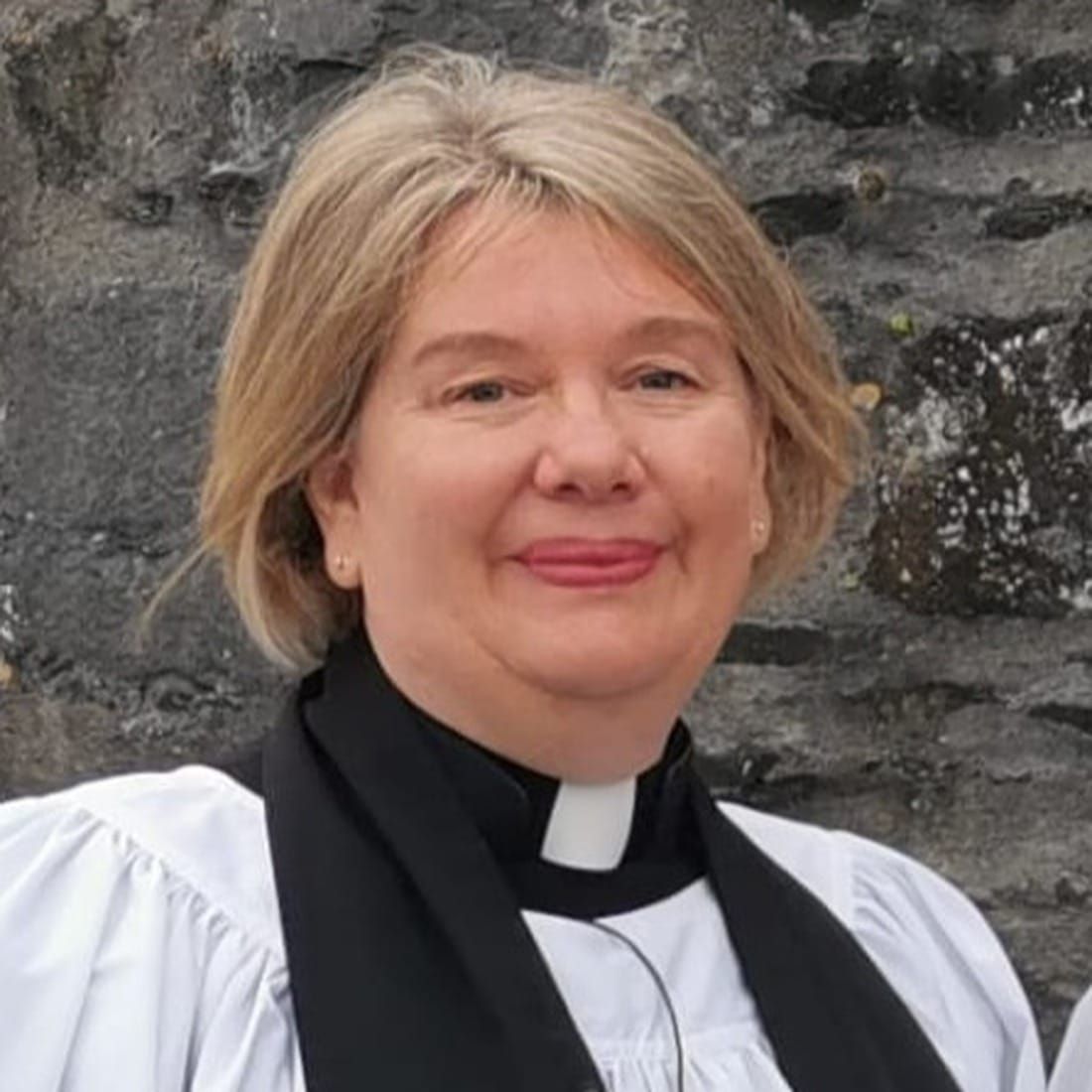
Isobel was eight when she told God that if there was anything she could do for him, he should let her know. She calls it her first mistake. Twenty years later she was on a plane to Africa.
Av Maria Solbak Årnes · Video conversation with the Very Revd Isobel Jackson, Dean of Kildare and Rector of the Kildare and Newbridge Group of Parishes, Church of Ireland · 9 September 2026 · 18 October 2026
The mistake of an eight-year-old
MARIA Do you feel you had a calling?
But when I was maybe eight years old was when I made a faith commitment and went to God. And I made a big mistake, I realise now. When I was thanking God for all he had done for me through Jesus, I made the mistake of an eight-year-old, saying: if there's anything I can do for you, just let me know.
That same moment, God told me I was going to Africa. I was eight. So I always knew that there was a mission, something there, that I was going to work Africa. But obviously I didn't know how.
Because I'm very shy, and I don't speak out my faith, I thought: I'm going to be a nurse, like my cousin, who was working in different places in the world. So I said, okay, that's what God wants me to do. He wants me to be a nurse, and I will go to Africa.
Her second mistake, I suggested.
Second mistake. He closed every door for nursing, so I never made it. Instead I ended up as a layperson taking services in Dublin for the Methodist Church in Ireland, and eventually full-time for a Home Missions Department project.
I made the mistake of an eight-year-old, saying: if there's anything I can do for you, just let me know.
Isobel Jackson. Born in Sligo, raised in Rathmoylon, Co. Meath. Worked for the Methodist Church Home Missions in Tallaght, Dublin, before moving to Uganda in 1998 as a mission partner supported by Church Mission Society Ireland. Ordained in 2004 in the Diocese of Ruwenzori, Western Uganda. Returned to Ireland in 2005 as Children's Ministry Officer in the Diocese of Cashel and Ossory and assistant priest in the Lismore group of parishes. Rector of the Templebreedy group in the Diocese of Cork, Cloyne and Ross from 2010. Appointed Children and Families Ministry Representative for the Diocese of Cork, Cloyne and Ross in November 2022, after eight years on the diocesan children's ministry group. Instituted as Rector of the Kildare and Newbridge group and installed as Dean of Kildare in St Brigid's Cathedral on 22 June 2023. Sources: Dioceses of Meath and Kildare, Dioceses of Meath and Kildare, installation, Church of Ireland, Diocese of Cork, Cloyne and Ross.
Studying with her father
MARIA You were brought up in a Christian family?
Yes. My father used to be a lay minister in the church. In fact, I had no intention of going into ministry. I was happy in children's ministry, doing things without ordination.
But my dad wanted to do the studies. While he helped in church, he had never done them. He left school at the age of fourteen. So he asked me, when I was seventeen, would I study with him for this lay ministry, because he needed me to help him with spelling. He could spell better than me. But anyway, we studied together.
I said, I don't mind doing Old Testament, New Testament, whatever. But I'm not doing the practical. The practical, I knew, was preaching a trial sermon in front of a congregation. So I said no, not interested in that. But I will study with you, and I'll encourage you.
So when I was nineteen, both of us were accredited in the Methodist Church as local preachers. And I found myself standing in a pulpit saying to myself: Lord, how did I get here?
God knows me well. Drop me in the middle of the deep end, I will swim. But I won't jump in.
Drop me in the middle of the deep end, I will swim. But I won't jump in.
Twenty years to the aeroplane
MARIA And you ended up going to Africa.
Eventually, at the age of twenty-eight, I'm on the aeroplane twenty years later, going to Africa. And I did not go there to get ordained, or even to end up at a university. But anyway, God turns the tables.
When you look back, it was an amazing blessing. To study divinity in the Church of Uganda, in the university I was in, was very biblically based. It was a privilege, because I was studying with other people from East African countries. Some were already ordained and wanted to improve their education. Others were going into counselling or different things. And some were going to be ordained.
MARIA And then you came back to Ireland.
Where I was ordained, I was living at a university. So it was very different coming back to Ireland, to a parish ministry.
But Ireland is my home country, and I was brought up in the Anglican Church as well as the Methodist Church. It was a blessing. We could have stayed on in Africa. But God very much put it on my heart that in Ireland we were needed more. Because in Uganda, eighty per cent of the people went to worship on a Sunday. People were very much involved in Christian life, and God came into everything. Before every meeting, Christian or secular, they prayed that God would be in the meeting. Very different to Europe.
So God called us back to Ireland, and we've been here ever since. My path to ministry has been slightly different to others.
Deacons in the sixties
MARIA What were the attitudes to women priests where you studied?
The Anglican Church is very broad. In Uganda they were ordaining women deacons from the early seventies. So even before Ireland.
If I as an Anglican priest now want to work in Australia, and if I go to the Diocese of Sydney, they won't accept women priests. But if I cross the River Hawkesbury to Newcastle Diocese, they will accept women. That's within the Anglican Church. In Tanzania, they are now ordaining women to the priesthood though the decision is made at the individual diocesan level rather than nationally across all dioceses. So it depends on where you are in the world.
In Uganda there were women clergy, so there wasn't any issue whatsoever. Even among the other clergy on my course, coming from Kenya and from Congo and Burundi, there was no issue with women.
Sometimes it is cultural as well for women priests in Uganda. They would say: oh, the men are afraid of us, they don't want to marry us because we're priests. Although that was twenty years ago, so it has changed more.
MARIA Is there something to that, that men would not pick a woman who is a priest?
I can see it in an African culture, because it depends on education. Uneducated men would think you don't want a wife like that. I don't think it's like that in Europe, but in Africa, just because of the culture, and where men and where women stand in the community.
Women are always seen as lesser than. But it hasn't stopped women becoming judges and becoming very high powered, professional people. And they still treat the men with great respect.
It's definitely biblical
MARIA Is there any justification in the Bible for the view that the man should be the head of the woman?
Yes, it's definitely biblical. And you also have to put Scripture into the culture of the time.
From a ministerial point of view, I never wanted to be ordained. I didn't want to be in church leadership. But despite myself, God put me in it. Even though I didn't want to be in a position of leadership, God opened doors that I had to go through.
So to me, what Paul is saying is of his culture and of his time, and it is different to ours.
MARIA Paul argues from creation, from Adam being made before Eve. And submission is mentioned throughout the Bible. Isn't that a sign that it might be the will of God?
I believe the Bible is the Word of God, and I try to follow it, can I explain from my own story why God has done things differently? I have experienced that God has chosen to use me, even though I didn't feel worthy, and even though I didn't feel that that was my calling in life in that way.
Sometimes we put God in a box and say God is like this. Paul was also a human being. I don't know how women and men were in congregations then. They would have been separate to each other, no doubt. There were different ways of worshipping together, and cultural norms.
So I understand what Paul is saying in his time. But all I can say is that I didn't try to be in this position. I would have quite happily run the other direction.
I have experienced that God has chosen to use me, even though I didn't feel worthy.
The head of my family
MARIA What is the Bible to you?
Yes, I believe it is God's inspired Word.
MARIA Then how are we to understand the letters of Paul? To me it reads as though he is saying how women should behave in church and towards their husbands, in general.
I hadn't been thinking through these things before our conversation, funnily enough.
I consider my husband as the head of our family because he is the man of the house. So, what is submission? For me it means respectfully supporting my husband's servant-hearted leadership, it’s in effect a mutual respect, which is a blessing when one's husband is a committed Christian, a respect patterned after the relationship between Christ and the church. So, I have no problem with Paul's words.
People can take the word submission and say, well, you're the boss, that somebody is reigning over. But it's like Eve was taken from Adam, from his rib and his side. She is beside him. So to me, submission is walking together and respecting each other. Somebody else can take the word submission and think of it as something totally different.
I also look at Jesus's relationship with the women around him. And while the disciples are named and all are men, no one can tell me that the women weren't involved in the ministry.
I consider my husband as the head of our family. So what is submission?
MARIA So are there female roles and male roles?
When you look at the women around Jesus, nobody was going to be writing down women's names, they were not formally educated and were not given the same respect at that time. It was men that were spoken about. So I'm sure women did have roles in those days. In the Old Testament women served as prophets, judges, and military figures like Deborah, women managed households, engaged in commerce and real estate, protected family members.
MARIA Do you think Jesus may have had female apostles who were not mentioned?
Well, there were certainly women who believed in him and followed him. They may not have been called apostles, but I believe they were all disciples. They were believing in him the same as the men and they were sharing their faith, like Timothy's grandmother a believer who first held and modelled a genuine, sincere, and authentic belief in God, instilling it in her daughter, who in turn taught the scriptures to her son Timothy.
2 Timoteus 1,5 (MANTELEN NT)
idet jeg blir minnet om den oppriktige troen som er i deg, den som først bodde i din bestemor Lois og din mor Eunike, og jeg er overbevist om at den også er i deg.
Silence on one side of the room
MARIA Paul writes that women should be silent in the congregation and ask their husbands. That is hard to align with a woman leading a church. How do you read it?
I was listening to a conversation with N. T. Wright recently. He was speaking about Kenneth E. Bailey American author, professor of theology who worked in the Middle East across all his career basically and he'd been in many village congregations and he said that often in village churches you would have the main worship service in Arabic but the women wouldn't understand the Arabic because they were local village girls who only spoke the local dialect.
The men would understand Arabic because that's how you did business. In those churches you would have men on one side and women on the other side, still the case in some Arab Christian churches to this day.
Bailey said that in his experience sometimes when the preacher was preaching in Arabic the women who didn't understand were all together on one side would start whispering among themselves out of boredom.
He had heard preachers say ‘please will the women stop talking among themselves’ if you want to know what's going on ask your husband when you get home.
In Pauls time the women would only speak the local dialect, I don't know if that's the right explanation but what you cannot deduce through this is that women must never say anything in church because in 1 Corinthians chapter 11 on the question about whether you wear head coverings or not it's assumed that women are leading in prayer and prophecy and if they were then that would technically go against a kind of blanket reading of 1 Corinthians 14:34–35 which says that women must be completely silent. Maybe Bailey’s theory works.
I think Bailey's theory is an interesting insight into the culture of the time, and what may have been going on in the place of worship.
Six churches and a Romanian congregation
MARIA How was it in Ireland when the practice changed?
At that stage I was not involved in the Anglican Church at that level, and unless you were in leadership you wouldn't have been very aware of it.
I know that the bishop who invited me back to his diocese, when I came from Africa, initially was not in favour of women clergy. He said that at the beginning he wasn't in favour, but then realised, when the women were around the table for a meeting, that it brought another dimension to thinking and planning. And he was very much welcoming of women in the end.
So at the beginning some people obviously had some thoughts, but it was accepted very readily. I haven't come across anybody in the Church of Ireland who had a negative approach to women in ministry, in all of my time of ministry here.
And I've had the same reception from the Roman Catholic Church. In the south of Ireland the majority of people are from a Roman Catholic background, and the majority of churches are Roman Catholic. But in small towns and villages you work together. Where I have worked, with my Roman Catholic colleagues, there was never any question about me being female at all. Their way of looking at ministry was: this is our village, and we are the pastors.
So I would visit the Catholic schools and sometimes give talks, and the Roman Catholic priest was welcome into our school. In all the villages we would do Christmas carols together and World Day of Prayer Service.
MARIA Tell me about the parish you are in now.
I have six churches in my parish. That would have been six parishes originally, with six clergy. The churches are very old, one hundred to two hundred years old, a Cathedral of St Brigid which is over eight hundred years old. They're in the centre of the community, and we maybe use them once on a Sunday, so it's not a lot of use. Heritage buildings are expensive to keep. So I open the churches for appropriate music, concerts, or plays and local festival arts in the town.
One of my churches is shared with a Romanian Orthodox congregation. They came and asked whether they could use the building. My congregation is elderly, maybe twenty-five or thirty people. The Romanian church meets before us, from half past seven in the morning until half past nine, and they have a lot of young families. It's a very different way to us, but the community together has been really good. It's encouraging the older people. And it's a big thing for them to share their building. But they have seen the blessing in us.
We just had a parish barbecue in the summer, so all the churches came together. The Romanian pastor came with his wife and his children, and everyone was so delighted to see them. Our congregation have been invited to their Romanian movie night in the church recently, thankfully it was in English.
One of the churches I pastor is a Cathedral in a town setting. When the local Roman Catholic church was getting a new roof and being refurbished over a period of a year, in the nineteen seventies, when there was a war going on in Northern Ireland between Protestants and Roman Catholics, the Roman Catholics were having mass in our building.
This is our village, and we are the pastors.
Portrett
Terskelen
Isobel is the first woman in this series to answer that the male headship of the household is biblical, and to say she has no problem with Paul's words. She is also a priest with six churches and a bishop's stand-in duties. Both things are true at once, and she does not resolve them by reading the verses away. She reads submission as respectfully supporting her husband's servant-hearted leadership, a mutual respect patterned after Christ and the church, and then lets the tension stand: she believes the Bible is the Word of God, and she has experienced that God has chosen to use her even though she did not feel worthy.
Her account of the Anglican Communion is the most concrete geography anyone in the series has given. Uganda ordained women deacons from the early seventies, before Ireland. Cross one river in New South Wales and the answer changes. In Tanzania they are now ordaining women to the priesthood at diocesan level, not nationally. The same communion, the same texts, three answers.
Two questions remain for the editor. If Scripture is God's inspired word, word by word, what work is the culture of the time doing when it sets a verse aside? And if the man is the head of the household by Paul's reasoning from creation, why does that reasoning stop at the door of the church? The other side has the floor before we pass judgement.