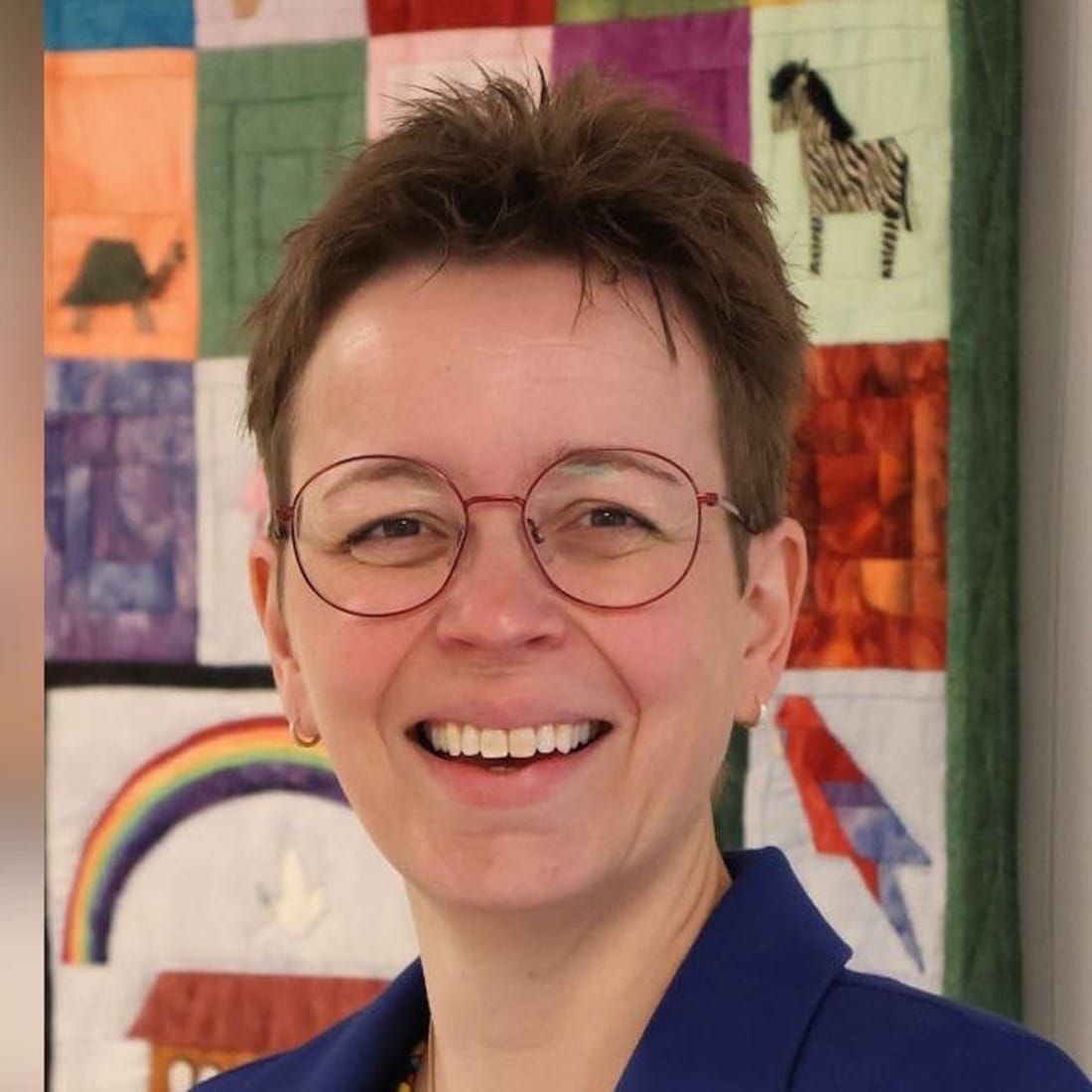
Marieke den Braber is one of five ministers in the Protestant Church in Barneveld in the Netherlands. Her male colleagues in the village belong to the same national church. They can preach from her pulpit. She cannot preach from theirs.
Av Maria Solbak Årnes · Video conversation with dr. Marieke E.J. den Braber, minister in the Protestant Church in Barneveld (NL) · 29 September 2026 · 12 October 2026
One national church, two pulpits
The conversation begins with a map of her village.
So here in Barneveld, I'm part of one church, the Protestant Church in the Netherlands. There in the village, there are other churches that also belong to the Protestant Church in the Netherlands, and I can do everything within my own church, but I can't do anything in that other church.
Officially, we belong to the same national organization, but that's as far as it goes. My male colleagues respect me, and we can chit-chat, have fun, and so on, but we can't change from one pulpit to another. They can come to my church, I can't go to the pulpit in their church.
Marieke den Braber accepted the call from the Protestant Congregation of Barneveld (Protestantse Gemeente Barneveld) in 2022. Barneveld lies in Gelderland, in the middle of the country. Source: Barneveldse Krant, 2 May 2022.
They can come to my church, I can't go to the pulpit in their church.
No state church
MARIA Thank you. Oh, yeah, a bit confusing. Do you have some church that is like the official state church?
No, in the Netherlands, we don't have a state church. Once upon a time, the Netherlands have formed a church, the Dutch Reformed Church. It was related to the state, but it is already in 1795 that state and church were officially beginning to be separated by law. It took until 1983 before the last bits of the financial ties between state and church were cut. Churches are now, also financially, fully indepedent.
So since then, the state has no influence anymore on the church. It's even so that the church is officially a free space, and in law, it says that during a congregation meeting or a service, that's an enclosed meeting, and police can only enter when there is someone in danger, there's violence going on, and life is endangered.
We have now and then these places. Currently, we have one in Kampen. There in a church live refugees who, according to law and according to decisions of judges, have to leave the country after twelve years that they have lived here, and the church says that's not human anymore what you're doing to these people, because their children are born here. They only talk Dutch. They go to the schools here.
So they live now in the church, and now for a second year already, there's 24 hours a day a service going on. So they keep the police outside in that way, because they say there's a service going on, so the police may not enter our church. They're not allowed to.
Church and state. For a long time the Dutch state paid the salaries and pensions of ministers under a provision of the constitution. An Act of 7 December 1983 ended the financial relationship between State and Church. In Kampen, the Protestant congregation Open Hof has held an unbroken church service since November 2024 to shelter a family from Uzbekistan whose asylum applications were rejected; by November 2025 the family had lived in the Netherlands for twelve years. According to NOS, the police may not enter a place of worship while a service is under way. Sources: Staatsblad 1983, 638, NOS, 21 November 2024, NOS, 20 November 2025.
We don't have a state church. Every church decides for themselves. Most have a kind of synod. But our church is the Protestant Church in the Netherlands, a national church of approximately 2 million members in the country, over 2,000 different parishes, and then in our city, there are two branches, so to say.
My local church in Barneveld is what we call the Protestant branch, and the other local branch of the same Protestant Church in the Netherlands still call themselves the Reformed branch. And this Reformed branch has no women ordained in any role in the church, has no women priests, don't agree on same-sex relations or marriage.
In our branch of the church, we have ordained ministers since the 60s that are women. Approximately the same time, at the end of the 60s, we decided we could ordain women in any role in the church. We have people of the same sex that marry in our church, that are present in all kinds of roles. They can be a minister, they can be a youth worker, they can be an organ player, they can be whatever they can be. Their sexual orientation is no issue.
The same arguments
MARIA My impression is that the arguments on both sides, both the issue of women as priests and also the same-sex marriage, the arguments are quite similar. You have people pointing at creation and the order that God made, and using many of the same places in the Bible. Is that your impression too?
Yeah, I think you find a lot of arguments that you find in the one discussion and in the other. And creation is one. It's a famous one.
We have, again, the texts of Paul coming in, and the texts that are used for the position of women in church. They are also used for the position of women in the house and the institution they live in. In my church, creation texts are more important nowadays for those who still feel some kind of uncomfortable with our approach to same-sex relations.
When you then ask them, how do you think about the people in the church you meet? I mean, there are several same sex couples in our church, and they participate in all kinds of things. Then they say, yeah, but these people are fine, and they can do, but I have issues about homosexual relations in general and about the rules.
So, since it's in our church a common policy, they kind of separate what they think and how to talk about it from the people they see. It's kind of tricky, because if they like these people, they're positive, and if they don't like the people, then they say, yeah, you know, it's also because God said that. And then I say, you know, no, that's what you read in the Bible. How you read the bible, is your interpretation, and that's not necessarily the same as 'God said so'. It's how you read these texts and how you interpret it.
How you read the bible, is your interpretation, and that's not necessarily the same as 'God said so'.
Context first
MARIA And how do you answer them, then, when they come with the quotations and examples?
I listen to them, but I also ask them, how do you think about the texts when they were written? What was the context by then? I, for myself, but that's also my colleagues, what they do. We're five ministers in this church. We tend to relate the Bible also to its original context. So, when you understand it in the original context, then you better understand why something was written and why it was so important by that time.
And that creation in Genesis, that it's pure poetry, and that it's beautifully written Hebrew, but it's something different. I'm now currently preparing a Bible class about creation and evolution, and all kinds of scientific proof of what's going on outside in the deep space, and so on. And then an important issue, again and again with Bible texts, is to remember when they were written, for whom they were originally written.
And our world is completely different nowadays from those. So, what's the message that springs over this time, from the time it was written, let's say 500 before Christ, and now 2000 after Christ? So, 2,500 years in between, and there's a message that goes over, but it's not so that you can easily plant rules, habits and so on, from one spot to another and say it's easily fitted on.
So, that's mostly how I start a discussion. A little explanation also about context, and also about what's your image of God. Why do you think that He says these things to the people, what they can do and what they can't do?
I can't come to the right English word, but why does God say these things, and why do you think that these are important for the people by then, and how can they be important for you nowadays? And what's the total image of God that you have, and how do these things fit in? And sometimes you come to the conclusion with people that the image of God they have doesn't completely coordinate with the strict interpretation of rules they have.
Take it all into account that that comes with. When you say Scripture says, then it's not only Scripture, but it's layered on all these things that you get from tradition.
They say 'translation' is 'treason': every time you translate something, you loose something of the original meaning, exact phrasing etcetera. And you add new interpretation, meaning and more. And every translation comes with tradition, with culture. And so our Bible interpretion is always subjective: tradition, translation and time/culture are influences that are always part of it. That's why it is important to know your own time, culture and language. As well as those of biblical times. To realise what is typical of them, en what influences the texts and your interpretation.
When you say Scripture says, then it's not only Scripture.
Fifty years after the first
MARIA So do you know how the church argued or presented the case when they changed view on women, for example, being ordained?
I have to guess, because that was a long way before I was born, and I know that the discussions were with the texts of Paul, but also with New Testament interpreters that said, we have to relate it to the time when it was said, that some of the very vigilant texts are pseudo-Paul, aren't really Paul, but you can relate it to authors that write in the style of Paul. So there was a huge influence from New Testament scholars, but it was also society. I mean, in the 1960s, we had here flower power times going on, so everything should be possible.
I think it also helps people say, okay, strict rules is maybe not anymore the kernel. And in our church, we weren't the first. I think it was 1910, 1915, something like that, in the Mennonite church in the Netherlands, there was already a female pastor. So when my mother church decided to have female pastors, there were already for over 50 years female pastors in the Netherlands. And an important argument was that, oh, you can preach like a man.
So the quality of the first female pastors was very important for the case. It's not fair, but they had to prove that they were as good as men, or as bad as men can be, to equal the level or the standard that was set, and the proof of the pudding was also in the eating. To be honest, the first women that became a minister were from privileged families.
So that helped the case. Most women who were ordained in the first years had already been students in theology for quite a long time, and had been preparing for the job, awaiting the positive decision for quite some time, since the mid-50s. Women were allowed to study about 15 years before it was possible for them to be ordained. That's how it worked, yeah.
Women in the office. The Protestant Church in the Netherlands was formed on 1 May 2004, when the Dutch Reformed Church (Nederlandse Hervormde Kerk), the Reformed Churches in the Netherlands (Gereformeerde Kerken in Nederland) and the Evangelical Lutheran Church merged. The Dutch Reformed Church opened the offices of elder and deacon to women in 1957 and admitted women as ministers in their own right in 1967. The Reformed Churches opened the offices of elder and deacon in 1967 and that of minister in 1969, and the first women were ordained in 1970. The first woman ordained in any church in the Netherlands was Anne Zernike, a Mennonite (doopsgezind) pastor, in 1911. Sources: Margriet Gosker, Historisch tijdschrift GKN, Reformed Churches in the Netherlands, Mennonite World Conference.
They had to prove that they were as good as men, or as bad as men can be.
Reading Paul
MARIA I find it very interesting, because I don't know anything about the history of the church in the Netherlands. But you mentioned how people often come to you with their concerns about what the Bible says, what Scripture says. How do you read Paul's letters? What are we supposed to take from them?
I think it's very important that you take into context, for example, the famous thing, have you to cover your head, and can you speak in public, that you have to be aware that it's a context where Paul is writing in Greek society, where a loose hair is also a sign of sexual morality that's not to be promoted, where in society there are different standards going on from how we nowadays relate to each other, so you have to take that into account a lot.
Also, how it worked with women and children, men in society, how Greek law was organized, what was the Roman law where he was living in, and what society was living in. And although he wanted to give the Christian message a huge boost in society, he also tried to work it into society, not as a contra society, like we make our own standards of living, but we have to live as Christians in the world, and that was part of his days.
And I think Paul's often used to say women are not allowed to speak in church. I think that famous quotation is one from pseudo-Paul, isn't Paul, and it's from a writer who used the name of Paul to be even more strict.
I think in the texts that we nowadays think are really Pauline, you also find the female disciples, and you also already find them in Acts, where you find the roles for the female often at the base of Christian communities. They were there, and they supported these communities, had important roles in these communities, that do not correlate positively with that they should have kept their mouth shut. Like you have Dorcas in Acts 9. When you have these women in small Christian communities, and you have it in Philippi, you have it in other places where you meet them in Paul, and I think in the end Paul did not disagree with women in important positions in church.
I think in the end Paul did not disagree with women in important positions in church.
The Other, with a capital
MARIA No, because when I read Paul, and I am no theologian, just a Christian trying to read the Bible, he sounds quite progressive. He does not look down on women. He says they can speak of God and of Jesus, that they can bring people to faith, and that they are of equal worth. I think the debate is more about roles, whether God intended certain roles for men and for women. As I read Paul, women should submit to their husbands as the husband submits to Christ. When the man has Christ as his head, it is good for the woman to have the man as her head. Do you think there is something true in that order, in submission, since it comes up in several places in the Bible?
Yeah, I think there's indeed, we have different qualities, and that's also for men. I think submission does not mean that you have to obey in every circumstance, and that you still have your own voice, that you still have your own way of, like you said, hey, you can people bring to faith, and so on.
But also then I turn back to the creation story, and then God created men and women, and the way I read it is not that men are preferred to women, but they're equally created to keep each other in kind of balance, but you need one another as you need Christ, to keep in balance and keep the right one on top.
MARIA So you don't read it as the man being the natural leader of the family and of the woman? Paul writes that she was created as his companion, for him. The creation story doesn't say that, but some read the wording of those passages as reserving the highest position in the family, and some say in the church, for the man.
Yeah, I think that I, from my tradition, come from one where we say, okay, it was by then very important to keep the man in that standard also, because society was orientated in that way, and that you have to interpret his words also, that by that time it was very important to keep the male in that position, and that we now tend to read it like what qualities requested God from people, what requested God for men and women to do, to obey, to listen to. They are equal for God, and can live equally before Him.
And, yeah, I'm more from the equal approach then, although I also agree that biologically, we're not the same. I mean, there's a difference women can do things men can't do biologically, and vice versa. What also sometimes means that you need that specific quality of the other to keep standing in your family.
But yeah, I'm more from the nowadays equal approach, not disagreeing with Paul, but reading Paul in the context and saying, okay, it was by that time very important to set one above the other. But is it really about setting one above the other, or is it also listening to Christ and deciding in your home what's best for your home? And that's huge responsibility, and that's not easily done without the other, and the Other with capitals.
That's not easily done without the other, and the Other with capitals.
A minister's daughter
MARIA I wonder about your background. Did you come from a Christian family?
My father was a minister. He was in the same church. I'm nowadays a minister.
He was very positive about it. He found it very nice when I said I also wanted to go for the ministry, but he said, okay, do you know what you're up to, because it's incredibly heavy sometimes. And he had very difficult times in the ministry. He was a minister during what we had here in the Netherlands in the beginning of the 80s, mid-80s, huge discussions about atomic weapons. You were pro or contra, and that were difficult times, and other things.
But I ended up in the ministry, and it's very good. This weekend, we had the 50th anniversary of the marriage of my parents, and then we had a small service in the church, and then we all do our part, and all of the children are very different in how they do it.
I ended up in the ministry, and it's very good.
Portrett
Terskelen
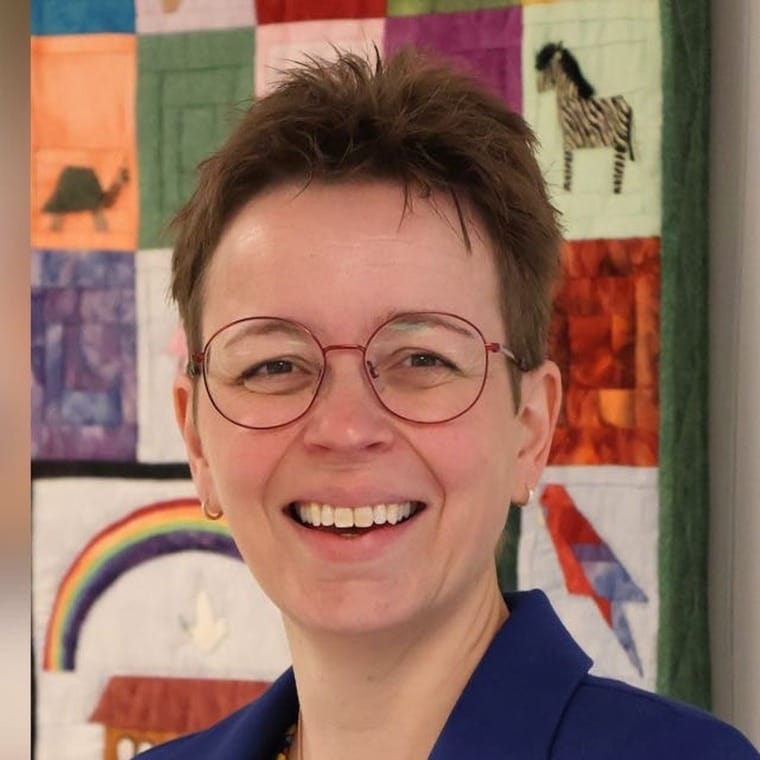
In Barneveld the line between the two positions runs through one village and one national church. Den Braber's colleagues in the other congregation can stand in her pulpit. She cannot stand in theirs. They respect her, she says, and they can have fun together.
Her reading of the disputed texts begins with context. When someone tells her that Scripture says, she asks when the text was written, and for whom. What they read, she reminds them, is a translation carried by tradition. On Paul she points to the women in Acts and in his letters, Dorcas among them, who had important roles at the base of the first communities. That does not fit with silence.
She places the best-known prohibition with a later writer who used Paul's name. Many scholars date the letters to Timothy and Titus after Paul's death, while others hold them to be his. The command that women keep silent in the churches stands in First Corinthians, which is not disputed as Paul's, though some scholars regard those two verses as a later addition. We have asked her which she meant.
The men in this series who hold the opposite view will want to put her own question back to her. If every reading of Scripture is layered with translation and tradition, what guards a reading of context against the same layering? They have the floor first.